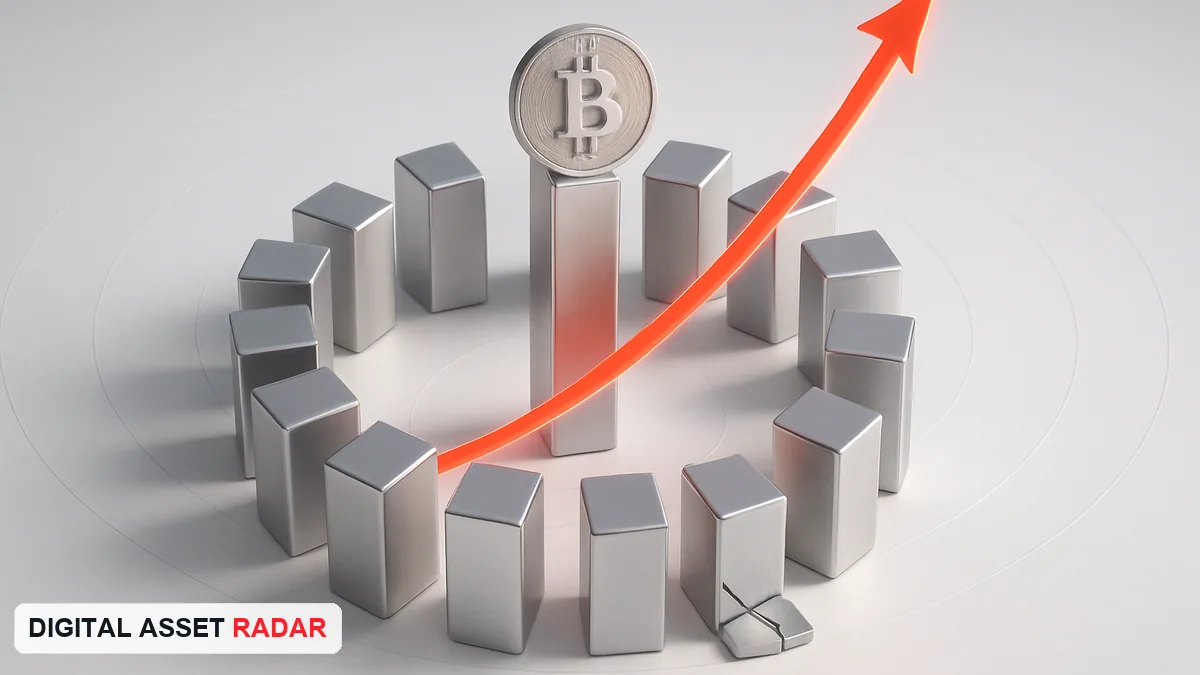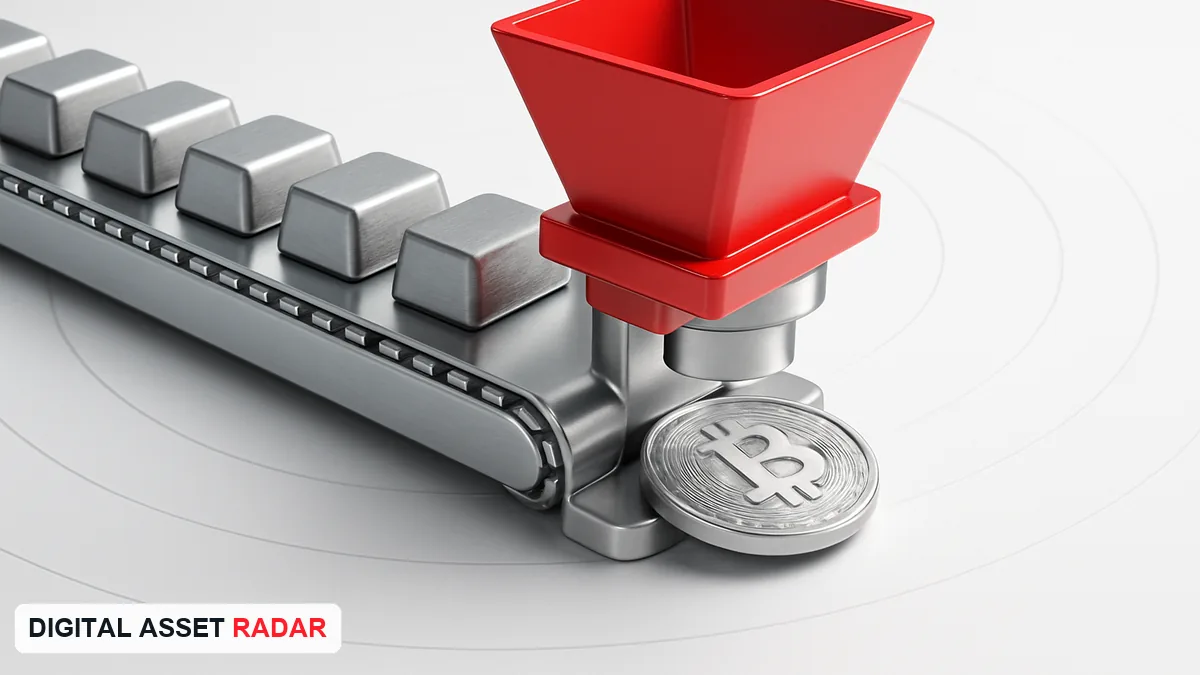
The Franklin Templeton Bitcoin ETF is a pair of dividend-reinvestment funds, filed on June 18, 2026, that hold ordinary US dividend stocks and route the dividend cash into Bitcoin exposure automatically — no exchange, wallet, or manual trade required. Alongside a BlackRock income fund launched two days earlier, it signals that Wall Street has stopped selling Bitcoin and started packaging it for every type of investor.
Key takeaways
- Franklin Templeton filed two Bitcoin DRIP ETFs on June 18, 2026 that hold US dividend stocks and convert the dividends into BTC exposure on a fixed calendar.
- BlackRock’s iShares Bitcoin Premium Income ETF (BETA) launched June 16, 2026 — a covered-call fund targeting a 15–25% annualized yield rather than accumulation.
- A September 2025 SEC rule change cut crypto ETF review from up to 240 days to roughly 75, opening the floodgates; Bitwise forecasts 100+ crypto ETFs in 2026.
- These products create price-insensitive, automated demand — a structural buyer that keeps buying even as retail panic-sells a 52% drawdown.
- The counter-case: layered fees, valuation-blind buying, and a product wave that historically marks tops, not bottoms.
What is the Franklin Templeton Bitcoin ETF?
The Franklin Templeton Bitcoin ETF is really two funds — the Franklin US Equity Bitcoin DRIP Index ETF and an innovation-focused version — both filed under form 485APOS on June 18, 2026, per the filing. The broad fund tracks a Wilshire index of nearly 500 large-cap US companies. But instead of reinvesting those companies’ dividends back into their own shares, it takes the dividend cash and buys Bitcoin exposure with it.
The design borrows a 100-year-old idea. A dividend reinvestment plan, or DRIP, automatically buys you more shares each time a stock pays out, quietly compounding a position over decades. Franklin’s twist points that same machinery at BTC. The fund starts at roughly 95% stocks and 5% Bitcoin, rebalances back toward 4.5% quarterly when Bitcoin drifts higher, and caps Bitcoin exposure at a hard 20%. That exposure is accessed through a mix of spot Bitcoin ETFs — including Franklin’s own EZBC — plus CME futures and listed options held inside the fund.
The genius is in the boredom: it strips out every friction point that stops an ordinary investor from touching crypto. No sign-up, no seed phrase, no nerve-wracking buy button. You own dividend stocks, and Bitcoin accumulates as a byproduct. The earliest launch date is September 1, 2026.
How BlackRock’s Bitcoin income ETF differs
BlackRock’s entry solves the opposite problem. The iShares Bitcoin Premium Income ETF, ticker BETA, launched on June 16, 2026 — two days before Franklin’s filing — and it is built for income, not accumulation. BETA holds spot Bitcoin and shares of BlackRock’s own IBIT, then sells call options on roughly 25–35% of those holdings.
A covered call rents out the future upside on an asset you own in exchange for cash today. BETA passes that cash to investors as monthly income, targeting a 15–25% annualized yield while aiming to retain about 70% of Bitcoin’s price moves, at a 0.65% fee. If you want the full mechanics of how these products trade away your upside, our breakdown of Strategy’s STRC and its 11.5% Bitcoin yield walks through the same trade-off.
Side by side, the pattern is clear: Franklin built a tool for the investor who wants to accumulate BTC without thinking, and BlackRock built one for the investor who wants income instead of upside. Bitcoin has been sliced into flavors and sold to every archetype at once.
Why Wall Street is building Bitcoin buyers while retail panics
The timing of the Franklin Templeton Bitcoin ETF is what makes it strange. As of early July 2026, Bitcoin sits around $59,500 — down roughly 52% from its October 2025 all-time high of $124,720. The 14-day RSI is near 31, the Fear & Greed Index printed 13 (extreme fear), and US spot Bitcoin ETFs have bled about $6.35 billion over seven weeks, with a single late-June day seeing nearly $692 million exit. Total spot ETF assets have collapsed from roughly $170 billion at the peak to about $73 billion.
Into exactly that fear, the deepest pools of capital on Earth are laying pipe for automated buying. The reason the floodgates opened so fast is a quiet regulatory switch: in September 2025 the SEC approved generic listing standards for crypto ETPs, cutting the review clock from up to 240 days per bespoke filing to a roughly 75-day conveyor belt. Bitwise’s Matt Hougan predicted an “ETF palooza” of 100-plus crypto products in 2026; Bloomberg’s James Seyffart described issuers “throwing a lot of product at the wall.” Franklin’s September 1 target is driven entirely by that 75-day clock. For where the price itself might be finding a floor, see our look at three on-chain signals for the Bitcoin bottom.
The retirement money angle: $47.6 trillion in play
The reason these funds matter is scale. DRIP-style products create price-insensitive, recurring demand. Vettafi’s Ryan Scholer called the Franklin structure a “programmatic dollar-cost-averaging tool” — the dividends pay on a fixed calendar regardless of the headlines, and the broad fund’s underlying index yields around 1.05% a year. That mechanically converts roughly 1% of assets into Bitcoin annually, on autopilot, whether BTC is at $124,000 or $59,000.
Now scale it against retirement money. Total US retirement assets sit near $47.6 trillion, of which roughly $7.5 trillion sits in equity-focused IRAs and 401(k)s — exactly the dividend-paying pools these products plug into. BlackRock has floated a “modest” 1–2% Bitcoin allocation as a diversifier; even 1% of the total pile is about $476 billion, and a 5% sleeve approaches $2.4 trillion. That is a demand channel that dwarfs today’s entire ETF market and, as Deutsche Bank’s Marion Laboure notes, Bitcoin’s price is increasingly set by fund flows. A discretionary ETF buyer dumps at the first macro scare; a DRIP buyer cannot be switched off, because the buying is baked into the fund’s mandate.
Real adoption or a Wall Street fee factory?
Here is the honest counterweight, and it is just as big. First, fees on fees. A Franklin DRIP investor pays the fund’s management fee, plus the cost of whatever Bitcoin instrument it buys underneath, plus the options and trading overhead on top. For context, Franklin’s own spot BTC fund charges 0.19% and a plain S&P 500 index runs around 0.03% — stack three layers over a 30-year horizon and the drag compounds into a real hole.
Second, valuation-blind buying. A classic DRIP has a stabilizer: when a stock falls, the dividend buys more shares cheaply. But this machine buys Bitcoin because some unrelated company paid a dividend, not because BTC got cheaper. It has no valuation filter — the same fund would have bought with equal enthusiasm at the $124,720 top.
Third, the froth signal. A flood of new crypto products has historically marked tops. The ProShares BITO futures ETF launched on October 19, 2021, about three weeks before that cycle’s ~$69,000 peak. The counter-argument, per Bloomberg’s Eric Balchunas: these funds are launching with BTC down 52% from its high, not pressed against it, and Michael Saylor framed the recent redemptions as “capital rotation, not a Bitcoin impairment.” My read is that both stories are reading from the same filing — the distribution is widening into trillions of retirement dollars, and the open question is whether that pipe carries real adoption or pure extraction.
Five signals to watch after September 2026
If you want to know which story is winning, watch five things once the Franklin funds go live in September 2026. One, the AUM — filings mean nothing until the products actually gather assets. Two, ETF flows stabilizing — the seven-week outflow streak ending signals the discretionary selling has exhausted itself. Three, the Coinbase premium index — a record 46-day negative streak flipping positive means US institutions are stepping back in. Four, the macro lever — with the Fed funds rate at 3.63%, the 10-year at 4.38%, and PCE inflation at 4.1%, bonds compete hard with BTC, so any rate-cut signal changes the game. Five, whether the product line fills out to Bitwise’s 100-plus forecast. For the wider institutional context, our piece on why Strategy sold Bitcoin tracks the same shift in the marginal buyer.
Frequently asked questions
What is the Franklin Templeton Bitcoin DRIP ETF?
It is a pair of ETFs Franklin Templeton filed on June 18, 2026 that hold US dividend stocks and, instead of reinvesting the dividends into those stocks, use the dividend cash to buy Bitcoin exposure. The broad fund starts near 95% stocks and 5% Bitcoin, caps BTC at 20%, and could launch as early as September 1, 2026.
How does the BlackRock Bitcoin income ETF (BETA) work?
BETA, the iShares Bitcoin Premium Income ETF, launched on June 16, 2026. It holds spot Bitcoin and IBIT shares and sells covered calls on 25–35% of them, passing the option premium to investors as monthly income. It targets a 15–25% annualized yield while keeping about 70% of Bitcoin’s price moves, at a 0.65% fee.
Are Bitcoin dividend ETFs a good investment?
They offer hands-off, automated BTC accumulation, which suits investors who won’t open an exchange account — but they stack multiple fee layers (fund, underlying Bitcoin instrument, and trading costs) and buy Bitcoin with no valuation filter. Whether they pay off depends on Bitcoin’s next decade and whether the assets actually arrive after launch. This is analysis, not financial advice.
Why is Wall Street launching Bitcoin ETFs during a bear market?
A September 2025 SEC rule change cut crypto ETF review to roughly 75 days, so issuers are racing products to market while the window is open. Because DRIP and income funds create price-insensitive, mandate-driven demand, launching them during a 52% drawdown positions them as accumulation vehicles rather than top-of-cycle speculation.
The bottom line
The Franklin Templeton Bitcoin ETF and BlackRock’s BETA represent a genuine shift: Bitcoin is being repackaged from a speculative bet into a financial ingredient — sliced into growth, income, and dividend flavors and wired into the deepest capital pools on Earth. Whether that pipe delivers structural adoption or just a well-dressed fee factory is the defining question, and the answer starts showing up in the AUM numbers from September 2026 onward.
This article is analysis and commentary, not financial advice. Always do your own research.