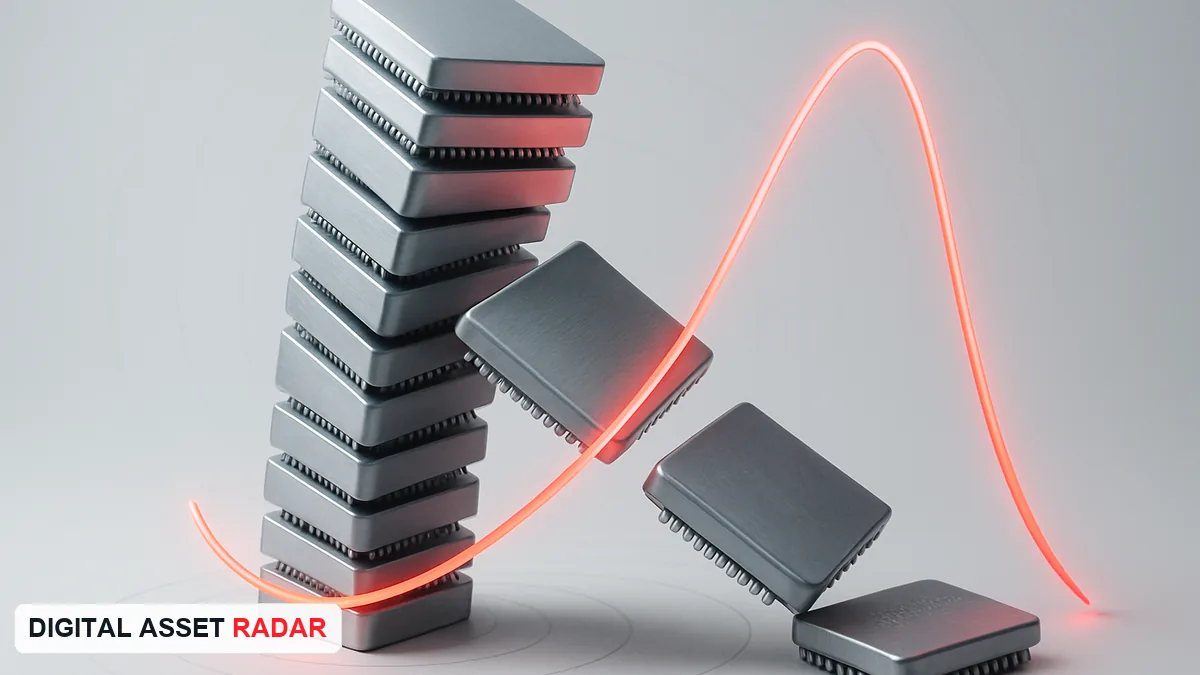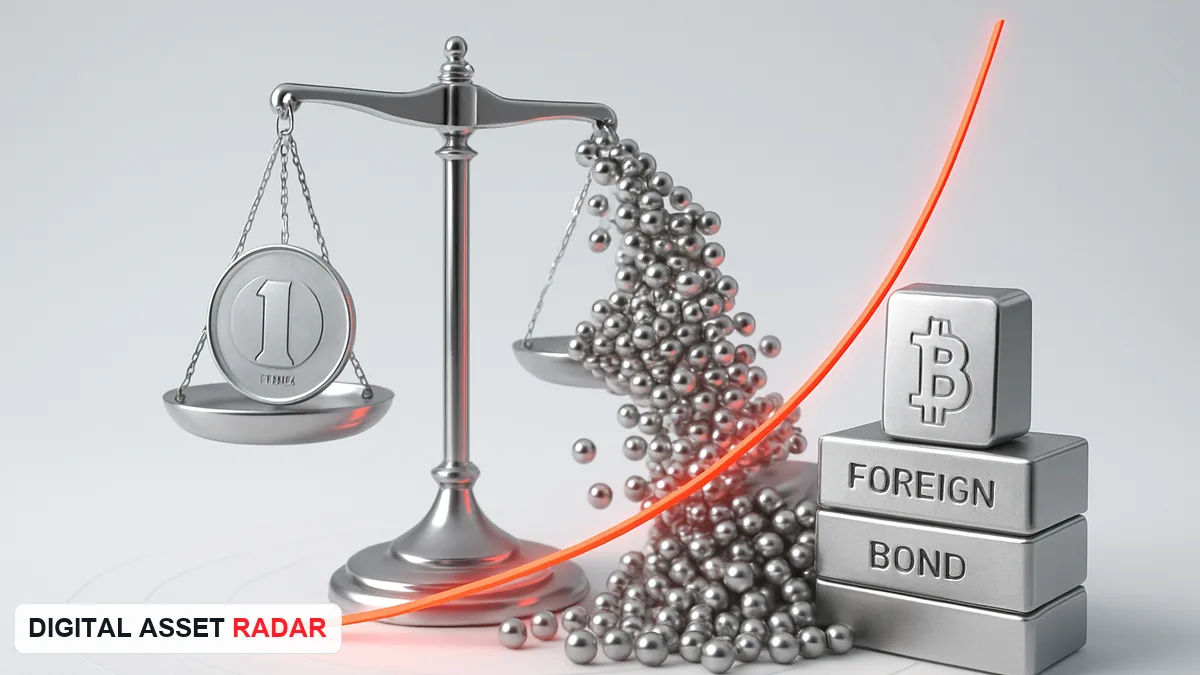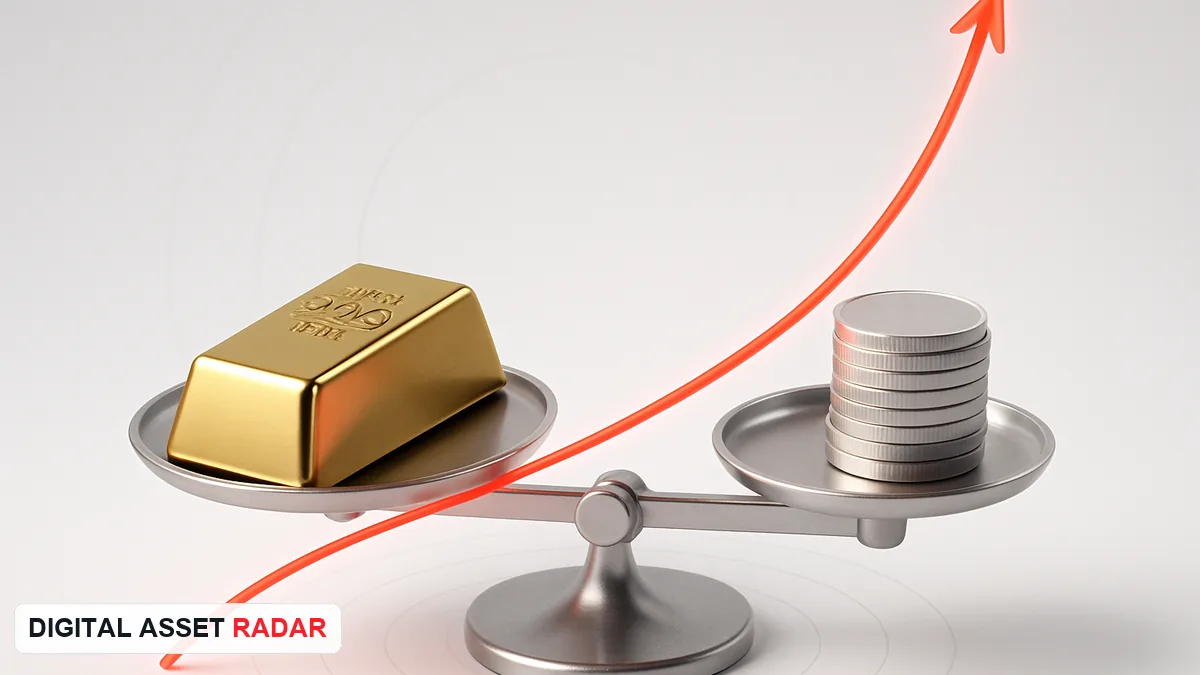
The great repricing is what happens when two forces we normally treat as opposites — a currency being debased on purpose and a technology making production almost free — arrive at the same time. Debasement pushes the price of everything up in dollars; artificial intelligence pushes the cost of making things down toward zero. Read separately they look contradictory. Read together they describe a single machine, and almost every thesis Digital Asset Radar has covered this year is one gear inside it.
This is the synthesis piece: not another interview summary, but an attempt to solve the puzzle by fitting the parts together. The claims below belong to the analysts we cover — Raoul Pal, Tavi Costa, Marc Faber, Benjamin Cowen, Clem Chambers and others — and are framed as their reasoning, not verified forecasts. What is new here is the arithmetic that connects them.
Key takeaways
- Two gears, one machine. Monetary debasement (inflation of the money supply) and AI deflation (collapse in the cost of production) are unfolding simultaneously, and they reinforce rather than cancel each other.
- Debt forces the printing. With population and productivity stalled, debt is the only remaining engine of growth — and servicing that debt is politically impossible without a debasing currency.
- AI supplies the productivity — and the deflation. The same buildout that might finally lift productivity also drives the cost of intelligence and output toward zero.
- Tokenization is the plumbing. Stablecoins, tokenized Treasuries and machine-speed settlement are the rails the repricing runs on — moving value out of the debasing unit and into programmable, scarce assets.
- The transfer is the point. Wealth flows from those who hold the melting unit (cash and wages) to those who own scarce, income-producing collateral — the mechanism behind the widening wealth gap.
The equation everyone is solving separately
Start with the textbook identity every macro analyst uses. Economic growth comes from three inputs: population growth, productivity growth, and debt growth. In Raoul Pal’s economic singularity thesis, the developed world — plus China — is failing on the first two at once. Populations are aging and shrinking; trend US GDP has slid from roughly 4% to under 2%, and much of the developed world now sits below 1%.
When two of the three engines stall, only debt is left to do the work. That single fact is the hinge the whole machine turns on. Everything that follows — the money printing, the AI capex, the flight into hard assets, the tokenized rails — is a downstream consequence of an economy that can no longer grow through people or, so far, through productivity, and so grows through leverage instead.
Gear one: the money is being debased on purpose
If debt is the only engine, the debt has to be serviceable, and the only politically survivable way to service an unpayable debt is to inflate the unit it is denominated in. This is not a conspiracy; it is the path of least resistance, and the numbers show it happening. US M2 money supply hit a record $23.1 trillion in May 2026, its fastest monthly jump in five years, per the data cited in our breakdown of dollar devaluation and the M2 record. Over six years the dollar has shed roughly 30% of its purchasing power — about 5% a year, compounding — while its share of global FX reserves has fallen from around 72% to 56%.
Clem Chambers puts a decade on it. In our write-up of the Fed “printathon”, he argues three forces — a runaway deficit, the reshoring of manufacturing, and the trillion-dollar AI buildout — all demand cheap capital, and that the result is 5–9% inflation for a decade. Marc Faber, no optimist, reaches the same destination by a different road: in his monetary-reset interview he says stopping the printing in a democracy is “practically impossible,” because the alternatives — higher taxes or spending cuts — are electoral suicide. Inflation is the tax nobody has to vote for.
Gear two: AI is making production deflationary
Here is where most macro commentary stops and the puzzle stays unsolved. The debasement story is only half the machine. The other half is that the cost of producing things is falling at the same time — and for a structural reason, not a cyclical one.
Pal’s framing is blunt: when knowledge and labour become abundant, the inputs that create inflation invert toward zero. Our piece on the AI supercycle reframes the whole business cycle as compute versus energy rather than capital versus labour — growth now scales with chips and power, and shortages are met with more capex rather than recession. In the supercycle thesis, intelligence is described as compounding roughly every six months, which is why no company or nation can afford to slow spending: the capex is a forced move.
So the same buildout that Chambers says requires cheap money is also the thing driving the cost of intelligence — and, eventually, of most output — toward the floor. That is the paradox at the centre of the machine: we are printing money to finance the very technology that makes things cheaper.
Why the two gears lock together
Put the gears side by side and they mesh. Nominal prices are pushed up by monetary debasement. Real production costs are pushed down by AI. The gap between the two is where the repricing lives.
This resolves what looks like a contradiction in the analysts’ own words. Faber warns that asset prices could rise in nominal terms while falling in real terms — stocks at all-time highs in dollars that are quietly worth less. Pal argues the AI deflation is why there may be no conventional bear market through 2028: liquidity and capex are too large to allow one. Both can be true at once. The dollar figure on your screen keeps rising because the unit is shrinking; the real cost of the underlying keeps falling because the machines are getting cheaper. What matters is no longer the nominal number but what you measured it in.
That is exactly the point Mark Moss makes in our analysis of the next financial crash: the coming event is a currency crisis, not a stock crash. The S&P 500 can keep printing highs in dollars while your purchasing power collapses — and the tell he watches is the European Central Bank reporting, as of June 2, 2026, that gold has overtaken US Treasuries as the world’s top reserve asset.
The plumbing: tokenization is the settlement layer
A repricing this large has to move through something. The machine needs rails, and the rails being laid are tokenized.
The institutional side is already live. The DTCC tokenization pilot is running real trades — not simulations — for tokenized Russell 1000 stocks, ETFs and US Treasuries, with around 40 institutions including JPMorgan, Goldman Sachs, BlackRock and the NYSE, and a full launch targeted for October 2026. The GENIUS Act forces stablecoin issuers to hold US Treasuries dollar-for-dollar, which quietly turns every dollar-pegged token into a distributor of US government debt — Tether alone already holds well over $120 billion in Treasuries. And the crypto-TradFi collaboration on tokenized collateral drew more than 300 participants from over 120 firms, with Circle, Ripple and Fireblocks sitting beside BlackRock, Citi and Swift.
Why does the debasement machine need blockchains at all? Because the AI half of it settles too fast for banks. In why AI agents need crypto rails, Pal’s forecast is that within roughly two years most transactions will be machine-to-machine, running “a million times faster than human neurons” — needing instant settlement, 18-decimal precision and wallet-based identity that KYC-bound, hours-to-settle banks cannot provide. The demand data already points that way: stablecoins now move roughly $76 billion per weekend, outpacing Visa’s daily volume, per Binance Research. The connective layer between the old system and the new is increasingly an oracle network — which is why big banks are betting on Chainlink even as the token lags the adoption.
Not everyone reads this as liberation. Catherine Austin Fitts, in our piece on the gold, XRP and the control grid, warns that the same programmable rails concentrate power — issuers can freeze or sanction a wallet with a line of code. The plumbing is neutral; who holds the valves is not.
The escape hatch: what gets repriced up
If the unit is melting and the rails are being built, the rational move is to hold whatever the unit is melting against. That is the demand behind every hard-asset thesis we cover.
Gold is the loudest signal. Central banks bought a net 244 tons in Q1 2026, the strongest first quarter on record, according to the reporting in our piece on China’s new gold system — and Beijing is throttling paper gold to build a physical-settlement rival to the dollar. Under Basel III, gold is now a Tier 1 asset, and the gold-revaluation thesis argues the US could reprice the ~8,100 tons still booked at $42/oz to $8,000–$10,000 to shore up its own balance sheet.
Bitcoin is the same trade with a different mechanism: scarcity plus network adoption rather than scarcity plus history. Pal’s rule, from the biggest crypto investing mistake, is that crypto tracks global liquidity (~87% correlation for Bitcoin) rather than a calendar — so global liquidity, not the business cycle, is the dominant driver. Benjamin Cowen’s cycle work adds the nearer-term map, arguing 2026 is a lower-volatility replay of 2018 and that the four-year rhythm isn’t dead yet. The debate over gold versus Bitcoin is real — Faber remains skeptical Bitcoin becomes a settlement currency — but both sit on the same side of the repricing.
The casualty: the wealth transfer
Every repricing has a loser, and the machine names it clearly. The people who hold the melting unit — cash savers and wage earners — lose ground to the people who own the scarce, income-producing collateral it melts against.
The mechanism is velocity. As our piece on the velocity of money and the wealth gap shows, a dollar sitting in savings, home equity or a single 401(k) position does one job or none, while the wealthy run the same dollar through multiple assets at once. The six laws of money describe the playbook: own rather than consume, borrow against appreciating assets rather than sell (sidestepping the tax that selling triggers), and treat scarce assets like Bitcoin as pristine, always-available collateral in a “hold, borrow, die” strategy. Faber frames the human cost bluntly — inflation is a regressive tax that hits people living paycheck to paycheck hardest, because necessities are a small share of a rich household’s budget and nearly all of a poor one’s. That is the K-shaped economy stated as arithmetic.
Solving the puzzle
Assemble the pieces and the nexus is a single sentence: because debt is the last engine of growth, the currency must be debased to service it; because AI is collapsing the cost of production, the value that leaks out of the currency has to land somewhere scarce; and because machines now transact faster than banks can settle, that value moves onto tokenized rails. Debasement creates the pressure, AI deflation sets the direction, tokenization builds the pipe, and hard assets are the destination. The wealth transfer is simply the difference between the people standing at the destination and the people still holding the pressure.
None of this requires the analysts to be right about timing — Faber and Pal openly disagree on whether inflation or deflation arrives first, and on whether Bitcoin belongs in the picture at all. It only requires the structure to hold: a system that cannot grow without leverage, cannot service leverage without debasement, and cannot resist a technology that makes debasement’s twin — deflation — arrive at the same time. Everything Digital Asset Radar tracks is a reading on one of those four gears. The great repricing is the name for all of them turning together.
Frequently asked questions
What is the great repricing?
The great repricing is the simultaneous effect of monetary debasement and AI-driven deflation. Debasement inflates asset prices in currency terms while AI collapses the real cost of production, so wealth shifts out of cash and into scarce, income-producing assets like gold, Bitcoin and tokenized real-world assets. It is a framework for connecting the macro, crypto and AI theses rather than a single predicted event.
How can inflation and deflation happen at the same time?
They operate on different things. Monetary inflation raises the number of dollars chasing assets, pushing nominal prices up. AI deflation lowers the cost of producing goods, services and intelligence, pushing real prices down. The result is nominal prices rising while real production costs fall — which is why an asset can hit all-time highs in dollars yet lose purchasing power, a point Marc Faber stresses in our coverage.
Why does the repricing need tokenization and crypto rails?
Because part of the new economy runs at machine speed. Raoul Pal argues most transactions will soon be agent-to-agent, needing instant settlement and sub-cent precision that traditional banking, with KYC and multi-day settlement, cannot deliver. Tokenized Treasuries, stablecoins and oracle networks like Chainlink are the plumbing that lets value move between the legacy system and blockchains — already visible in the live DTCC pilot and record stablecoin volumes.
Is the great repricing a guaranteed outcome?
No. It is a synthesis of analysts’ arguments, not a verified forecast, and they disagree on sequence and timing — whether inflation or asset deflation comes first, and what role Bitcoin ultimately plays. The structural claim is narrower: an economy dependent on debt for growth faces strong pressure to debase its currency, and that pressure coincides with a deflationary technology shock. Treat the destinations as scenarios to weigh, not certainties.