The Raoul Pal supercycle thesis argues that the world has entered “the biggest investment cycle in history,” and that the combination of unstoppable AI capital spending, rising liquidity, and a coming surge in productivity makes a normal bear market or recession in 2026, 2027, or 2028 extremely unlikely. In a solo presentation published on July 9, 2026, the Real Vision co-founder lays out why he thinks this cycle is a “phase change,” not another dot-com-style boom and bust.
This is a big, contrarian call, so it’s worth separating the mechanism from the conviction. Below we rebuild Pal’s argument as something you can actually evaluate — where it is rigorous, where it is a bet, and what would have to break for it to be wrong.
Key takeaways
- The supercycle claim: Raoul Pal argues there will be no full bear market or recession in 2026–2028 because AI capital expenditure and liquidity are too large to stop.
- Capex as a forced move: Because intelligence is compounding roughly every six months, no company or nation can afford to slow spending, so capex becomes strategic necessity rather than choice.
- Debt is the new fuel: Hyperscalers have shifted from funding data centres with cash flow to issuing debt — which, in Pal’s “everything code” framework, is itself an injection of liquidity.
- The open question is productivity: The whole thesis rests on productivity finally accelerating so that GDP growth outruns debt, the way it briefly did in the late 1990s.
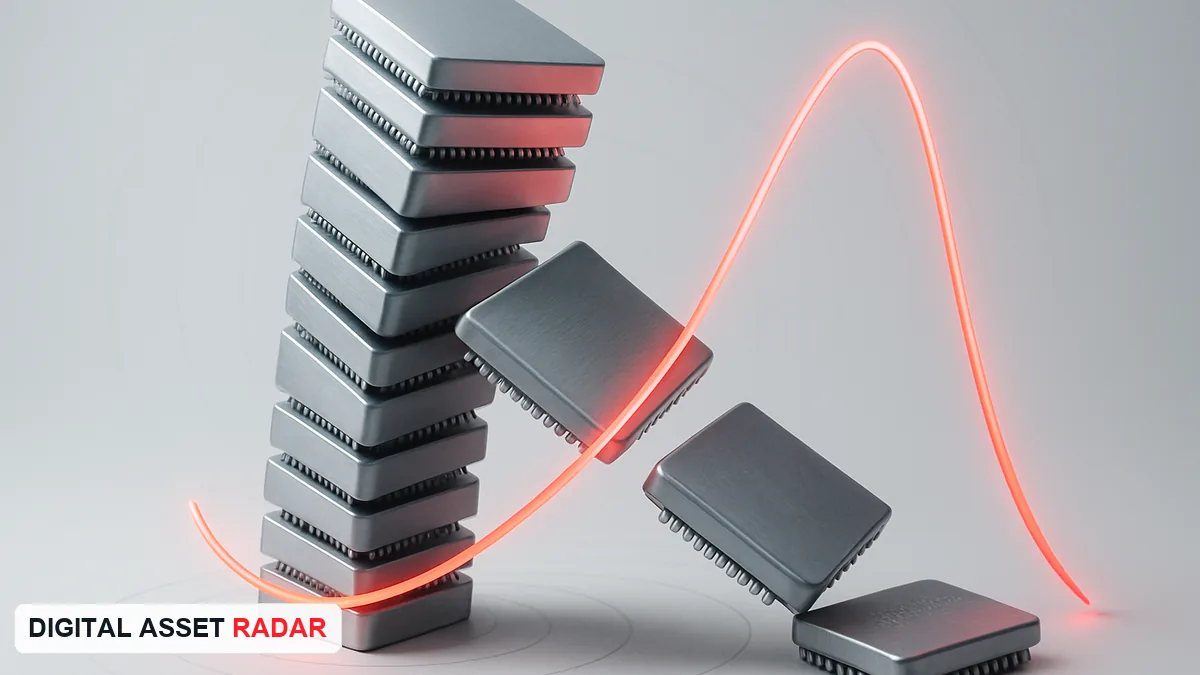
- He still expects corrections: Pal explicitly warns of sharp drawdowns — semiconductors down 50% at some point — inside a market that keeps rotating rather than crashing.
What Raoul Pal means by a supercycle
A supercycle, in Raoul Pal’s framing, is a multi-year expansion driven by a single dominant force — here, machine intelligence — that is powerful enough to override the usual business cycle. Pal draws on two frameworks he has developed: the “everything code,” which describes how currency debasement and liquidity push up scarce assets over time, and the “exponential age,” which describes intelligence itself going vertical.
The core of the everything code is a familiar macro identity: GDP growth equals population growth plus productivity growth plus debt growth. Pal argues all three engines have stalled in the developed world, leaving governments to paper over the gap with debt and currency debasement — the same dynamic we unpack in our look at Raoul Pal’s economic singularity thesis. His supercycle claim is that AI is about to restart the productivity engine, letting the economy finally grow faster than its debt.
Why AI capex won’t collapse like the dot-com bust
The obvious objection is that this looks like every prior technology bubble, and Pal’s presentation spends most of its time on why he thinks it isn’t. His central argument is that AI capital expenditure is a “forced move.” Because the amount of intelligence produced per chip is, by his measure, roughly doubling every six months, any player that slows down falls permanently behind. That removes the equilibrium where spending would naturally cool.
Pal makes a striking claim to illustrate it: if a major lab such as OpenAI went bankrupt, the effect would not be a crash but a scramble, because whoever bought the stranded compute would gain a near-monopolistic advantage. In his view the US government could not even allow one buyer to absorb it all. That is the opposite of a malinvestment story, where excess capacity sits idle.
He also argues the balance sheets are far healthier than the last capex boom. The telecoms that blew up in 2000 carried debt worth roughly 25–30% of their market capitalisation, some as high as 100%. Today’s hyperscalers, by Pal’s “dumb” measure of debt to market cap, sit near 4.5% — leaving enormous room to borrow. For a fuller version of the “this time the plumbing is different” argument, see our piece on when the AI bubble might actually pop.
How debt became the new fuel for compute
For most of the boom, the hyperscalers funded data centres out of cash flow. Pal marks 2026 as the year the switch flipped and they began issuing debt to go faster. That matters inside his framework because debt issuance is money creation — an increase in what he calls US total liquidity — being poured directly into a capex boom that cannot stop.
Two things reinforce it, he argues. First, the US Treasury is issuing heavily at the short end of the curve, which acts as ongoing stimulus and smooths out the usual cyclicality. Second, regulatory changes are pushing banks to lever up and absorb Treasuries, creating still more money. Pal estimates the economy could add roughly $24 trillion of debt by 2030 before hitting the level (around 165% of GDP) that broke it in 1929 and 2008 — total US debt sits near 140% today. The mechanism echoes the liquidity-driven asset inflation we describe in does global liquidity drive Bitcoin.
The one domino that has to fall: productivity
Here is where Pal is honest that the supercycle is a bet, not a certainty. His chain of dominoes runs: semiconductors lead the intelligence index, intelligence leads capex, and capex should eventually lead productivity. Productivity is the domino that has not yet moved. He cites the fastest revenue ramp ever recorded — pointing to Anthropic’s run-rate, which he describes as a “double exponential” — as early evidence that demand for intelligence is real and will compound into profits.
But he concedes the payoff is lagged, likely by around 18 months, and that official statistics may not even measure it well. “If productivity doesn’t pick up, then this game of intelligence would be a disaster,” Pal says. His conviction is that it will, comparing the moment to the late-1990s internet build-out but larger. According to the U.S. Bureau of Labor Statistics, productivity growth is the exact series that would have to inflect for the thesis to hold — a checkpoint worth watching rather than assuming.
The US–China intelligence race that can’t stop
Pal frames the supercycle as ultimately geopolitical. The United States and China are, in his words, “locked into a race where nobody can stop spending and nobody can stop accelerating.” If intelligence doubles roughly every six months, a country that suffers an 18-month recession would fall more than three years behind — an unrecoverable gap. That, he argues, is why neither side can permit a domestic slowdown, and why friction points like energy supply and rare-earth access keep getting resolved.
Using his own “exponential age index,” Pal claims the gap between the two nations has narrowed to about 0.2 months, with China accelerating via cheap solar energy and efficient open-source models while the US retains the lead in frontier intelligence. The takeaway is that the largest, most powerful states on Earth are both structurally committed to spending — which is the deepest reason he doubts the cycle can simply stop.
What could still go wrong
Pal is not calling for a straight line up, and it would misread him to say so. He explicitly expects “market corrections” and “rotations” inside the supercycle — semiconductors falling 50% or trading sideways for a year while other parts of the intelligence curve take off. His claim is narrower than “prices only rise”: it is that the aggregate cannot enter a sustained bear market because the capex and liquidity behind it are too large to reverse.
The honest risks are the ones baked into his own argument. If productivity never accelerates, the debt-funded compute becomes exactly the malinvestment he dismisses. If financial conditions tighten and the roughly $1.2 trillion in committed interest payments cannot be rolled cheaply, the liquidity engine stalls. And history is not on the side of “this time is different”: rail, electricity, and fibre all ended when debt compounded faster than revenue. Pal’s supercycle is a bet that intelligence compounds faster than the interest bill — which is precisely why it should be held as a thesis to test, not a guarantee.
Frequently asked questions
Will there be a bear market before 2030?
Raoul Pal argues a sustained bear market or recession in 2026–2028 is very unlikely because AI capital spending and liquidity are too large to reverse. He still expects sharp corrections — including semiconductors falling as much as 50% — but sees them as rotations within an ongoing supercycle rather than a full cyclical bust.
Is the AI capex boom a bubble?
Pal’s view is that it is not a classic malinvestment bubble because AI spending is a “forced move”: intelligence compounds so fast that any player who slows down loses permanently. He also notes hyperscaler debt is roughly 4.5% of market cap, far below the 25–30% that sank telecoms in 2000, leaving room to keep funding the build-out.
What is Raoul Pal’s everything code?
The “everything code” is Pal’s framework in which GDP growth depends on population, productivity, and debt — and, as those stall, governments rely on currency debasement and liquidity to keep asset prices rising. In that model, only two asset classes reliably outrun debasement over time: technology (the Nasdaq) and crypto, led by Bitcoin.
Why won’t AI capex collapse like the dot-com bust?
Pal argues the difference is who is spending and how. The 2000 telecoms were heavily indebted relative to their size, while today’s hyperscalers are cash machines with low leverage and, increasingly, cheap debt. Because compute is strategically essential to nations and firms, he believes any stranded capacity would be bought and put to use rather than left idle.