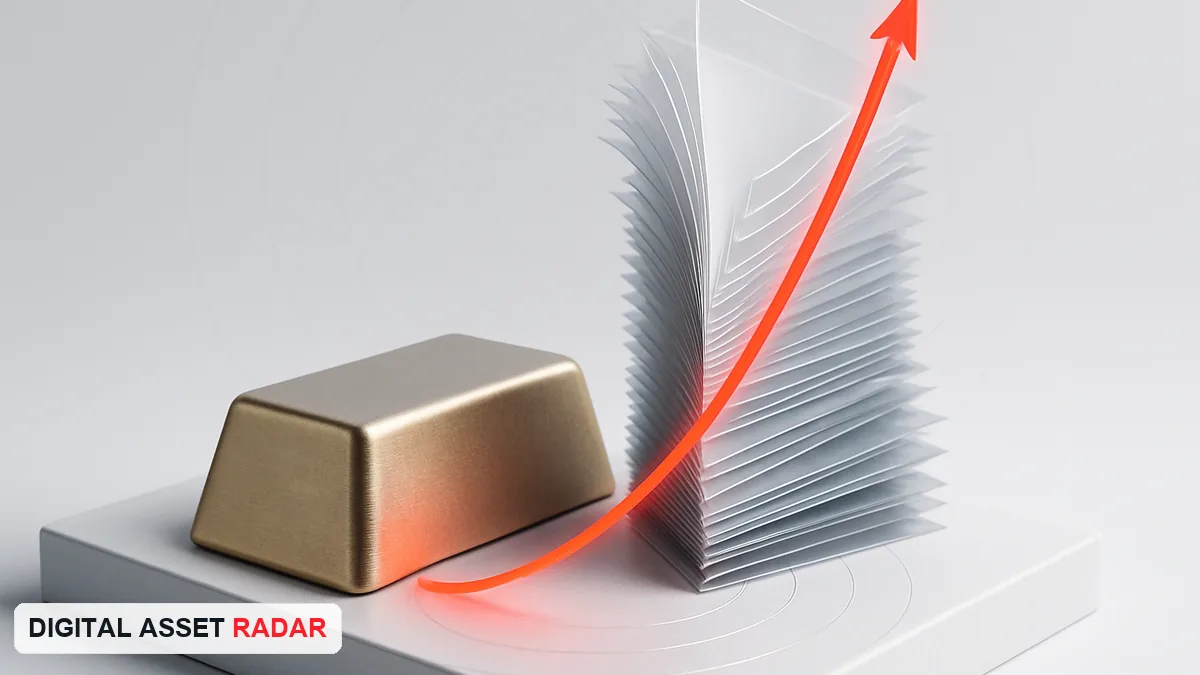
Paper gold is any financial product that tracks the gold price without giving you the metal — ETFs, futures, certificates and unallocated accounts. Physical gold is the coin or bar itself, owned outright with no one standing between you and it. The gap between the two matters most in a crisis, when a paper claim depends on a counterparty staying solvent and a physical bar does not.
That distinction has moved from a bullion-forum debate to a live macro question in 2026. Gold set an intraday record of $5,589.38 an ounce on January 28, 2026, central banks are buying the physical metal at a near-record pace, and China spent the summer switching off retail paper gold entirely. Below is a plain-English guide to what paper gold actually is, where the risks sit, and why the world’s biggest buyers keep choosing the bar over the claim.
Key takeaways
- Paper gold is a claim, not metal. ETFs, COMEX futures, gold certificates and unallocated bank accounts all track the price without transferring a specific bar into your name.
- Physical gold removes the counterparty. A coin or allocated bar you hold or store in your name has no issuer that can fail, freeze, or fall short on delivery.
- There is far more paper than metal. As of April 13, 2026, COMEX held roughly 76.9 million ounces of registered gold against open interest representing about 575.5 million ounces — near 7.5 paper ounces of exposure for every deliverable ounce.
- The smart money is buying physical. Central banks purchased 863 tonnes of gold in 2025 and the World Gold Council projects 700–900 tonnes in 2026 — reserves they take into their own vaults, not paper claims.
- The choice is about why you own gold. Paper wins on speed and cost for trading; physical wins on ownership and crisis insurance.
What “paper gold” actually means
Paper gold is an umbrella term for any instrument whose value moves with the gold price but which does not put a specific bar in your hands. The four common forms:
- Gold ETFs such as SPDR Gold Shares (GLD) and iShares Gold Trust (IAU). You own shares in a trust that holds gold; you cannot generally walk in and collect metal.
- Gold futures, traded on venues like the COMEX division of the CME, are contracts to buy or sell gold at a set price on a future date. Most are closed out for cash before delivery.
- Gold certificates and pooled accounts issued by banks and mints — a paper promise that a quantity of gold exists on your behalf.
- Unallocated accounts, where a bank owes you gold but no specific bars are set aside in your name.
All four give you price exposure. None of them, by default, make you the outright owner of a numbered bar. That is the line that separates paper from physical.
Allocated vs unallocated: the distinction that decides your risk
Within the metal itself there is a second, sharper split that most beginners miss. Allocated gold is specific, serial-numbered bars held in your name; the custodian is merely storing your property and the metal never appears on the bank’s balance sheet. Unallocated gold is a claim on a shared pool — you are an unsecured creditor of the institution, ranking alongside other lenders if it fails.
Unallocated gold is technically metal, but it behaves like paper: your access depends on the counterparty. This is why the phrase “you own gold” is not enough on its own. Owning GLD shares, an unallocated bank balance, and a bar in a safe deposit box are three very different levels of ownership, even though a price chart shows them moving in lockstep.
Why there is more paper gold than metal
The defining feature of the paper market is leverage: many more claims can be written than there is metal available to deliver. On COMEX as of April 13, 2026, registered inventory — the gold actually available for delivery — sat near 76.9 million ounces, while open interest represented roughly 575.5 million ounces of exposure. That is close to 7.5 paper ounces for every deliverable one.
This works only because the vast majority of paper holders never ask for metal. They are trading price, not accumulating a hoard, so the claims recycle without stress. The system is efficient precisely because almost nobody takes delivery — which is also its fragility. If enough holders demanded the physical bar at once, the paper market could not honour every claim at the posted price. Silver flashed a version of this earlier in 2026, when a physical squeeze briefly pushed premiums for real metal far above the paper price.
The counterparty risk paper gold carries — and physical doesn’t
Every form of paper gold introduces a chain of intermediaries: fund sponsors, custodians, brokers, clearinghouses, exchanges. Each link has to stay solvent and cooperative for your claim to be worth its face value. If a custodian fails, a broker freezes withdrawals, or an exchange changes delivery rules, your access can be delayed, restricted, or lost — even though the “gold price” on your screen never moved.
Physical gold in your possession collapses that chain to zero. There is no issuer to default, no account to freeze, and no delivery to fail. That independence is the entire point for buyers who treat gold as insurance against a systemic accident rather than as a trade. It is also the thread running through China’s 2026 gold strategy: as we covered in why Beijing killed paper gold, the country shut off retail paper products while building a physical-delivery settlement hub, a deliberate move from claims toward metal.
What the biggest buyers are doing
If you want to know which side of this trade the most informed money trusts, watch central banks. They bought 863 tonnes of gold in 2025, and the World Gold Council projects another 700–900 tonnes in 2026 — well above the pre-2022 average of 400–500 tonnes a year. Crucially, they are buying the physical metal for their own reserves, and they kept buying through the record run, adding at $4,000 and at $5,500 alike.
Sovereign buyers with the resources to hold gold any way they choose overwhelmingly choose allocated, in-vault metal over paper claims. That preference is a data point in its own right — the same logic we unpack in why the PBOC keeps buying gold and in our guide to whether now is a good time to buy gold. When the entities that issue the world’s paper currencies want protection, they reach for the bar.
Which one is right for you
Neither form is universally “better” — they answer different questions.
Paper gold is the efficient tool for price exposure: you can buy or sell an ETF in milliseconds, hold it in an ordinary brokerage or retirement account, and avoid storage and insurance costs. For a trader or someone who simply wants gold’s price in a portfolio, that convenience is the whole appeal, and the counterparty risk is a remote tail worth accepting.
Physical gold is the tool for ownership and insurance. It costs more to acquire (a dealer premium) and to keep (storage and insurance), and it is slower to sell. In return it removes every intermediary and every point of failure. For a buyer whose reason to own gold is precisely the scenario where financial plumbing breaks, that trade-off is the point, not a drawback.
The honest answer for many investors is a blend: paper for liquidity and easy exposure, physical for the core insurance holding you would never want to depend on someone else to deliver. What matters is knowing which one you actually hold — because as of July 2026, the difference is no longer academic.
Frequently asked questions
Is paper gold as good as physical gold?
For tracking the gold price day to day, paper gold works fine and is cheaper and faster to trade. It is not equivalent for ownership: paper gold is a claim that depends on a fund, bank, or exchange staying solvent, while physical gold in your name has no counterparty. If your reason for owning gold is protection against a financial crisis, the two are not interchangeable.
What are the main types of paper gold?
The four common forms are gold ETFs (such as GLD and IAU), gold futures traded on exchanges like COMEX, gold certificates or pooled accounts issued by banks and mints, and unallocated accounts where a bank owes you gold without setting aside specific bars. All track the price; none, by default, make you the outright owner of numbered metal.
Is there more paper gold than physical gold?
Yes. Far more claims are written than there is metal available to deliver. On COMEX as of April 13, 2026, registered inventory was about 76.9 million ounces against open interest of roughly 575.5 million ounces — close to 7.5 paper ounces of exposure per deliverable ounce. The market functions because almost no one takes delivery.
What is the difference between allocated and unallocated gold?
Allocated gold is specific, serial-numbered bars held in your name; you own the metal outright and it stays off the custodian’s balance sheet. Unallocated gold is a claim on a shared pool, making you an unsecured creditor of the institution. Allocated is true physical ownership; unallocated behaves more like paper because your access depends on the counterparty.