Hedera developers have introduced a portable identity standard for AI agents, giving autonomous software a single verifiable identifier that holds steady as it moves across different networks, registries and communication protocols. The announcement, flagged the first week of October 2026, targets a problem that gets worse every time an AI agent picks up a new wallet, API key or protocol to speak: it has no consistent way to prove it’s the same agent from one system to the next.
Key takeaways
- Hedera’s standard creates one persistent identifier for an AI agent that stays constant across MCP, A2A, blockchain accounts, API services and decentralized registries, while still mapping back to the agent’s native account in each.
- The problem is real fragmentation. An agent acting through different protocols today can exist under entirely separate identity systems with nothing tying them together as the same actor.
- Hedera isn’t alone in this race. Ethereum’s ERC-8004 standard already gives agents a persistent identity and reputation layer — Hedera’s move is a hashgraph-based answer to the same question.
- It arrives alongside a bigger institutional moment for Hedera’s codebase, which the Linux Foundation Decentralized Trust custodies as the open-source project Hiero inside its 2026 institutional adoption report.
- The “digital passport” framing is becoming the industry’s preferred shorthand for this entire category of blockchain-based agent identity.
What problem does an AI agent identity standard actually solve?
Identity fragmentation is already a headache for humans — anyone who has filled out the same intake form at five different doctor’s offices knows the feeling. For AI agents, the problem compounds. An agent operating through Anthropic’s Model Context Protocol (MCP), Google’s Agent2Agent protocol (A2A), a blockchain account, an API service, or a decentralized registry can exist under a completely different identity system in each one, with no common thread connecting them as the same actor.
That fragmentation is tolerable while agents are booking calendar slots or summarizing documents. It stops being tolerable the moment agents start moving money, signing contracts, or acting across organizational boundaries on a person’s behalf — which is already happening in early, small-scale form. If a counterparty, a regulator, or another agent can’t verify which entity it’s actually dealing with, the entire premise of autonomous agent-to-agent commerce breaks down before it starts.
How Hedera’s portable identity standard works
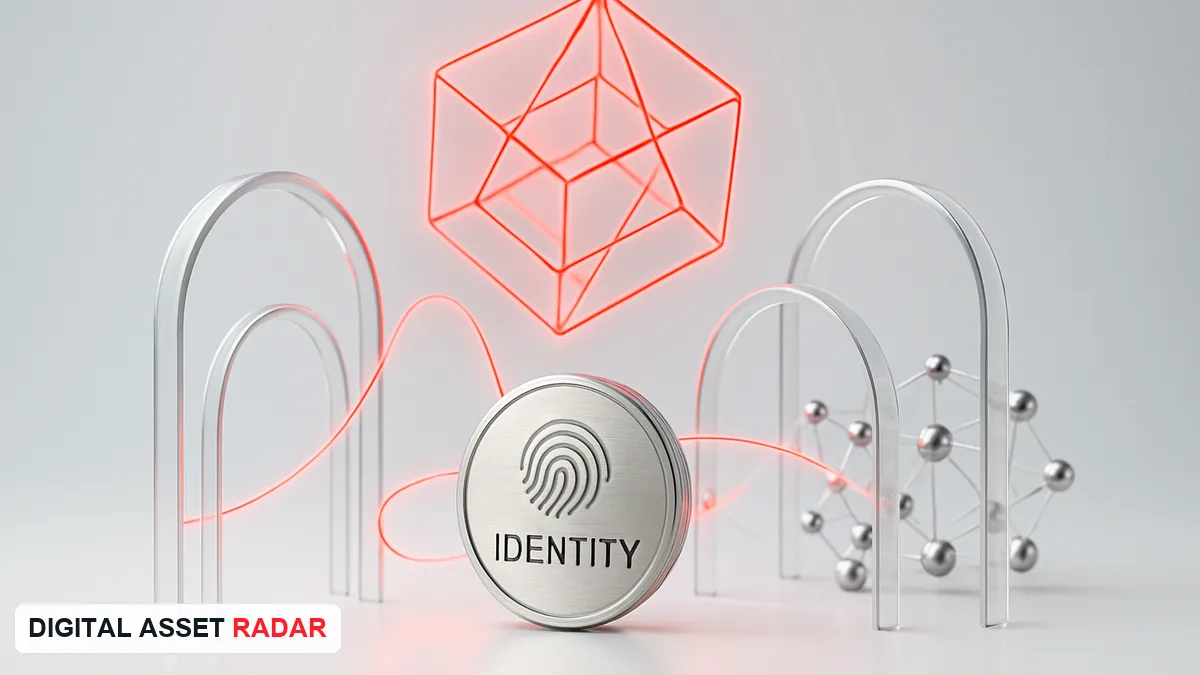
Per Hedera’s description of the standard, the goal is a universal identifier that remains consistent across environments while still mapping back to the agent’s native protocol registry or account. In practice, that means an agent doesn’t get forced onto one single login that every system must adopt — instead, it carries one root identity that resolves cleanly into whichever registry or protocol it’s currently operating through, whether that’s an MCP server, an A2A exchange, or a blockchain ledger.
The design goal is an identity that travels with the agent rather than being reissued at every stop. That distinction matters for anything that depends on continuity — a reputation score, a spending limit, a compliance record — because none of those can function if the agent resets to a blank slate every time it crosses into a new system.
The “digital passport” framing — and why plain language matters
One detail worth dwelling on is how this category of technology gets described to non-technical audiences. The host of the video this article is drawn from borrowed a phrase from an earlier interview about Algorand’s digital credentials work: a “digital passport.” It’s a useful analogy because a passport is a single, portable credential that different countries recognize without needing their own separate identity system for every visitor — exactly the job a portable agent identifier is meant to do.
The same instinct for plain language shows up elsewhere in crypto terminology. A multi-signature wallet — one that requires several parties to approve a transaction before it executes — is functionally just a joint account, the kind millions of people already hold with a spouse or family member. As agent identity standards move from developer documentation into mainstream use, framing them in terms people already understand (a passport, a joint account) will matter more than the underlying cryptography.
Hedera vs. Ethereum: two bets on agent identity
Hedera isn’t solving this problem alone, and it isn’t first. Ethereum’s ERC-8004 standard, which Digital Asset Radar covered in our explainer on agent-to-agent commerce, already gives AI agents a persistent identity plus a reputation layer — letting two agents transact without either side needing to disclose who operates them. Hedera’s new standard targets the same underlying gap — an agent that can prove it’s consistently itself — but builds it on hashgraph consensus rather than Ethereum’s account model.
Neither approach has to “win” outright. The same week this standard surfaced, the Linux Foundation Decentralized Trust published its 2026 institutional adoption report mapping tokenization infrastructure across dozens of networks — including Hedera, whose codebase the foundation has custodied as the open-source project Hiero since Hedera donated it roughly two years ago. We cover that report’s broader multi-chain picture in our analysis of Canton Network vs. Ripple’s XRP Ledger. The identity layer looks set to follow the same pattern as settlement: multiple competing standards on multiple networks, rather than one dominant protocol.
Why this matters now
Agent identity is the piece that has to exist before agent-to-agent commerce can scale past novelty use cases. Digital Asset Radar has previously covered macro investor Raoul Pal’s case for why AI agents need crypto rails in the first place — his argument centers on settlement speed and programmability, but speed is worthless if the parties on either end of a transaction can’t verify who they’re actually paying. A portable, verifiable identity is the missing piece that turns “an agent can move money fast” into “an agent can move money fast and be trusted to do it.”
As more agents begin transacting across MCP servers, A2A exchanges and blockchain registries simultaneously, whichever identity standards get adopted early — Hedera’s, Ethereum’s ERC-8004, or others still unannounced — will shape how much of that activity institutions are willing to let agents handle unsupervised.
Frequently asked questions
What is Hedera’s AI agent identity standard?
It’s a portable identity framework that gives an AI agent one persistent, verifiable identifier that stays consistent as the agent moves across different networks, registries and communication protocols, while still linking back to its native account or registry entry in each one.
How is Hedera’s standard different from Ethereum’s ERC-8004?
Both target the same problem — giving AI agents a persistent identity so they can be trusted across systems — but they run on different infrastructure. ERC-8004 is an Ethereum standard that pairs identity with an on-chain reputation layer; Hedera’s standard builds portable identity on hashgraph consensus instead of Ethereum’s account model.
Why do AI agents need a portable identity in the first place?
Without one, an agent operating through MCP, A2A, a blockchain account, an API service, or a decentralized registry can appear as a completely different, disconnected actor in each system. That fragmentation blocks continuity of reputation, spending limits and compliance records — all of which depend on proving an agent is consistently itself.
Does a portable identity standard let AI agents move money across different blockchains?
A portable identity standard solves the verification half of that problem — confirming which agent is acting — rather than the settlement mechanics themselves. It works alongside payment infrastructure like stablecoins and cross-chain messaging to let agents both prove who they are and move value across ecosystems.
Sources
The original source video, plus the independent sources this article’s key claims were checked against:
- Original video — King Solomon (Ryan Solomon). Watch the full discussion on YouTube.
- Hedera developers introduced a portable global identity standard for AI agents, announced the first week of October 2026. Broadly confirmed — PR.com — Hashgraph Online Launches HCS-14: Universal Agent IDs That Bridge Web2 and Web3. The standard (HCS-14) is real but was published by the Hashgraph Online (HOL) consortium on 10-11 September 2025, not newly introduced by Hedera in late 2026; Hedera re-promoted it around 30 September 2026
- The standard creates a universal identifier that stays consistent across MCP, A2A, blockchain accounts, API services and decentralized registries while still mapping back to the agent’s native registry or account. Verified — Hashgraph Online — HCS-14: Universal Agent IDs for Web2 and Web3. Spec defines a single portable UAID with embedded routing that either derives a deterministic AID or wraps an existing DID, covering A2A/REST, MCP, EVM and Hedera; Hedera support is explicitly optional
- Ethereum’s ERC-8004 standard gives AI agents a persistent identity plus a reputation layer. Verified — Ethereum Improvement Proposals — ERC-8004: Trustless Agents. Defines Identity (ERC-721 based), Reputation and Validation registries; still at Draft status, so the article’s ‘already gives’ is ahead of its formal standing
- The Linux Foundation Decentralized Trust published its 2026 institutional adoption report mapping tokenization infrastructure across dozens of networks, including Hedera, the same week. Verified — LF Decentralized Trust — New report: Institutional adoption of LF Decentralized Trust technologies. Published 29 September 2026 documenting 80 institutional deployments; Hiero sits inside LFDT’s own ledger stack alongside Besu, Fabric, Iroha and Lineth
- LF Decentralized Trust has custodied Hedera’s codebase as the open-source project Hiero since Hedera donated it roughly two years ago. Verified — Hedera — Hiero Turns One: Graduation and Growth. Donation dated 16 September 2024, about two years and two weeks before the article’s publication date