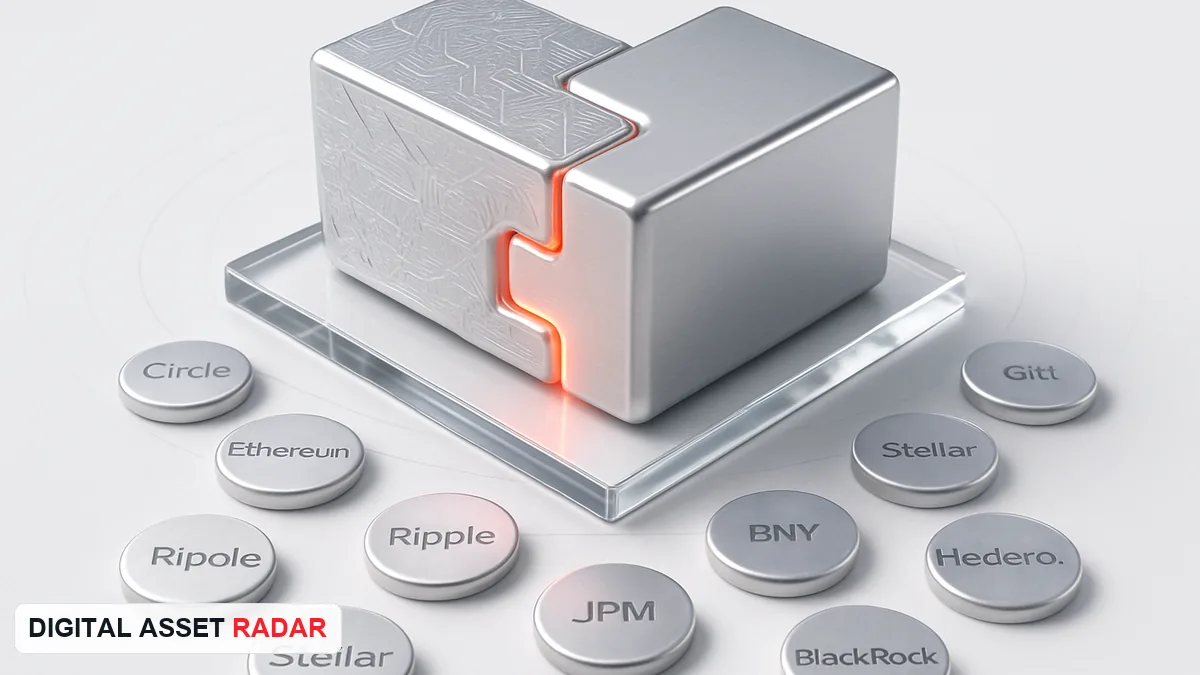
The clearest sign of crypto and TradFi tokenization collaboration is who is now in the room together: a July 2026 report from Global Digital Finance (GDF) and the International Swaps and Derivatives Association (ISDA) lists crypto-native firms including Circle, Ripple, Stellar, Hedera, Fireblocks and BitGo working alongside BlackRock, Citi, JPMorgan, BNY, State Street and Fidelity to make tokenized money market funds usable as collateral. After a decade framed as crypto versus banks, the most serious players in both camps are now building the same rails.
Key takeaways
- The story is the guest list, not a product launch. The GDF-ISDA working group drew more than 300 participants from over 120 firms, with 48 firms running live sandbox simulations — an institutional coordination exercise, not a conference panel.
- Crypto-native and TradFi names sit side by side. Circle, Ethereum, Ripple, Stellar, Hedera, Fireblocks, BitGo and Digital Asset appear next to BlackRock, JPMorgan, Citi, Goldman Sachs, State Street and Swift.
- The target is collateral, not speculation. The effort focuses on tokenized money market funds (TMMFs) that can be pledged, moved and reused to back derivatives, repo and margin obligations.
- The numbers explain the urgency. Real-world asset tokenized AUM hit $8.4 billion by May 2026, up 298% from 2024, against $1.6 trillion of non-cleared margin collected at year-end 2025.
- Adoption is on the calendar. Survey data cited in the report shows 66% of firms plan to launch TMMFs before the end of 2027, and 44% expect to accept them as collateral by then.
Inside the crypto and TradFi tokenization collaboration
The crypto and TradFi tokenization collaboration documented in the GDF-ISDA report is notable less for any single announcement than for its breadth. According to the report, titled Unlocking Capital with U.S. Tokenized Money Market Funds for Collateral Mobility, the working group brought together more than 300 participants across over 120 firms, with 48 firms participating directly in an industry sandbox powered by tokenization infrastructure firm Ownera.
That composition is the signal. For years the blockchain-in-finance debate was posed as a fight — crypto versus banks, public chains versus private ledgers, DeFi versus regulated markets. What the report captures instead is convergence: stablecoin issuers, custody platforms, blockchain foundations and smart-contract firms helping define how tokenized versions of traditional assets get issued, pledged, monitored and reused inside regulated capital markets.
Who brings what: the convergence stack
The clearest way to read the participant list is as a stack, where each side supplies a layer the other cannot. Digital Asset Radar’s framing splits it into three tiers.
Settlement and liquidity. Circle sits at the intersection of digital dollars and tokenized-asset settlement, where stablecoin liquidity and tokenized fund shares must interact. Ethereum matters as the reference architecture — even permissioned or hybrid builds lean on its standards, tooling and security practices. Ripple, Stellar and Hedera each represent a different network approach to payments and asset issuance, a reminder that tokenization will not be a single-chain story.
Custody and transfer. If tokenized fund shares become eligible collateral, institutions need wallet governance, approval workflows, transaction policies, audit trails and segregation. That is the territory of Fireblocks, BitGo and Copper, plus smart-contract security from OpenZeppelin and market data from Kaiko and RedStone.
Market infrastructure. Digital Asset, Ownera, Fnality and Tokenovate operate closer to the institutional plumbing — enterprise ledger technology, network infrastructure, tokenized settlement assets and post-trade derivatives lifecycle tooling. Together they point past mere issuance toward full transaction-lifecycle management.
Why the TradFi names are not passive observers
The traditional finance roster is not there for brand recognition. Asset managers such as BlackRock, Fidelity, Franklin Templeton, Invesco and Vanguard understand the fund-product layer. Custodians and banks including BNY, State Street, Citi, JPMorgan, Standard Chartered, Northern Trust and UBS understand collateral operations, client servicing and regulatory control environments. Market-infrastructure names such as Swift, CME Group, ICE, LSEG and S&P Global Ratings understand interoperability, clearing, settlement and ratings.
That combination matters because tokenized collateral cannot win as a front-end product alone. It has to survive the back office: recognized legally, transferable operationally, acceptable to regulators, usable by risk teams and integrable with existing market plumbing. These are the firms that know where the friction actually lives — which is why their participation, more than any crypto brand, signals that this has moved beyond a lab experiment. The legal and operational detail of that assessment is covered in our companion analysis of tokenized money market funds as collateral.
Why neither side can build this alone
The collaboration reflects a practical truth: crypto and TradFi each hold half the puzzle. Crypto-native firms bring programmability, wallet technology, token standards, custody tooling, oracle infrastructure and a culture of rapid experimentation. But capital markets demand more than code — legal certainty, settlement finality, regulatory treatment, transfer-agency rules, fund governance and insolvency analysis all have to hold.
Traditional institutions understand those requirements, yet many legacy systems are fragmented, batch-based and built around reconciliation rather than real-time state changes. That is precisely where tokenized ledgers help: a shared record, programmable transfer logic and faster visibility into ownership and collateral status. The point is not that everything moves to a public chain tomorrow; it is that institutions are now testing which pieces of blockchain architecture solve real market-structure problems. Tokenized collateral is the clearest candidate because the pain is real, the assets are familiar and the benefit is measurable — the same logic pulling regulated funds on-chain via Ondo Finance’s tokenized Treasuries and the bank infrastructure bets behind Chainlink.
The numbers behind the urgency
The economics explain why a niche-sounding topic drew Wall Street’s biggest names. According to the GDF-ISDA report, real-world asset tokenized assets under management reached $8.4 billion as of May 2026 — a 298% increase from 2024. Set that against $1.6 trillion of non-cleared initial and variation margin collected at year-end 2025, and the prize comes into focus: collateral that can move with more speed, precision and control across a very large part of the financial system.
The adoption window is closing in. Survey data cited in the report indicates 66% of firms plan to launch TMMFs before the end of 2027, while 44% expect to accept them as collateral by then — and only 33% view current money market fund processes as efficient. That is the classic setup for infrastructure change: a valuable asset class, inefficient workflows, a clear operational problem and a new architecture ready to be tested.
The Digital Asset Radar view
Tokenized collateral may become the first major blockchain use case where the value proposition is obvious to institutions before it is obvious to retail. Retail crypto markets fixate on prices, tokens and narratives; institutional adoption moves quietly through working groups, legal memos, sandbox simulations and custody integrations. That makes it easy to miss and, potentially, more durable.
The likely future is neither pure DeFi replacing Wall Street nor Wall Street absorbing blockchain without change. It is hybrid infrastructure — regulated assets, institutional controls, programmable rails, permissioned workflows and interoperable networks, migrating the most inefficient market processes first. The first era of crypto created new assets; the second traded them; the next may simply upgrade how existing assets move. For Digital Asset Radar, that is the real story: the biggest blockchain adoption story may not look like a viral launch, but like collateral moving faster between the institutions that already run global finance.
Frequently asked questions
Which crypto companies are working with banks on tokenization?
Per the July 2026 GDF-ISDA report, crypto-native firms including Circle, Ethereum, Ripple, Stellar, Hedera, Fireblocks, BitGo, Copper, Digital Asset, Ownera, OpenZeppelin, Kaiko and RedStone participated alongside banks and asset managers such as BlackRock, Citi, JPMorgan, BNY, State Street, Fidelity, Franklin Templeton and Standard Chartered. In total the working group spanned more than 120 firms.
What is the GDF-ISDA tokenized money market fund report?
It is a July 2026 report from Global Digital Finance and ISDA titled Unlocking Capital with U.S. Tokenized Money Market Funds for Collateral Mobility. It assesses whether tokenized money market fund shares can be pledged and reused as collateral across U.S. margin, repo and securities-lending workflows, backed by live simulations from a 48-firm industry sandbox.
Why are crypto and TradFi collaborating on tokenized collateral?
Because neither side can build it alone. Crypto firms supply programmability, token standards, custody tooling and settlement technology, while banks and asset managers supply legal certainty, regulatory treatment, fund governance and collateral operations. Tokenized collateral only works if it survives both the front end and the institutional back office.
How big is the real-world asset tokenization market in 2026?
According to the GDF-ISDA report, real-world asset tokenized assets under management reached $8.4 billion as of May 2026, a 298% increase from 2024. The report also cites $1.6 trillion of non-cleared initial and variation margin collected at year-end 2025 as the scale of the collateral opportunity.
Sources
- Global Digital Finance (GDF) and ISDA, Unlocking Capital with U.S. Tokenized Money Market Funds for Collateral Mobility, July 2026 — working-group and industry-sandbox participant lists, adoption survey data and market figures.
- Digital Asset Radar: Tokenized Money Market Funds as Collateral Explained — the report’s legal and regulatory findings in detail.